July 28, 2019

Hybrid of Hardy Tamarillo’s (Cyphomandra corymbiflora x fragrans) - part 2

On March 2019 I described my experiment with crossing of two half-hardy tamarillo species: Hardy Tamarillo Cyphomandra corymbiflora (female parent) and male Guava Tamarillo C. fragrans = C. diploconos (male parent). Now one of my hybrid plants is in flowers, so I am posting the new photos and description of an appearance of the hybrid (in table - comparison with the parents).
There is a table with comparison on various features of parents and the hybrid:


Features
hardy tamarillo
(Cyphomandra corymbiflora)
hybrid F1
(Cyphomandra corymbiflora x fragrans)
guava tamarillo
(Cyphomandra fragrans)
Leaf shiness
not shiny, mat
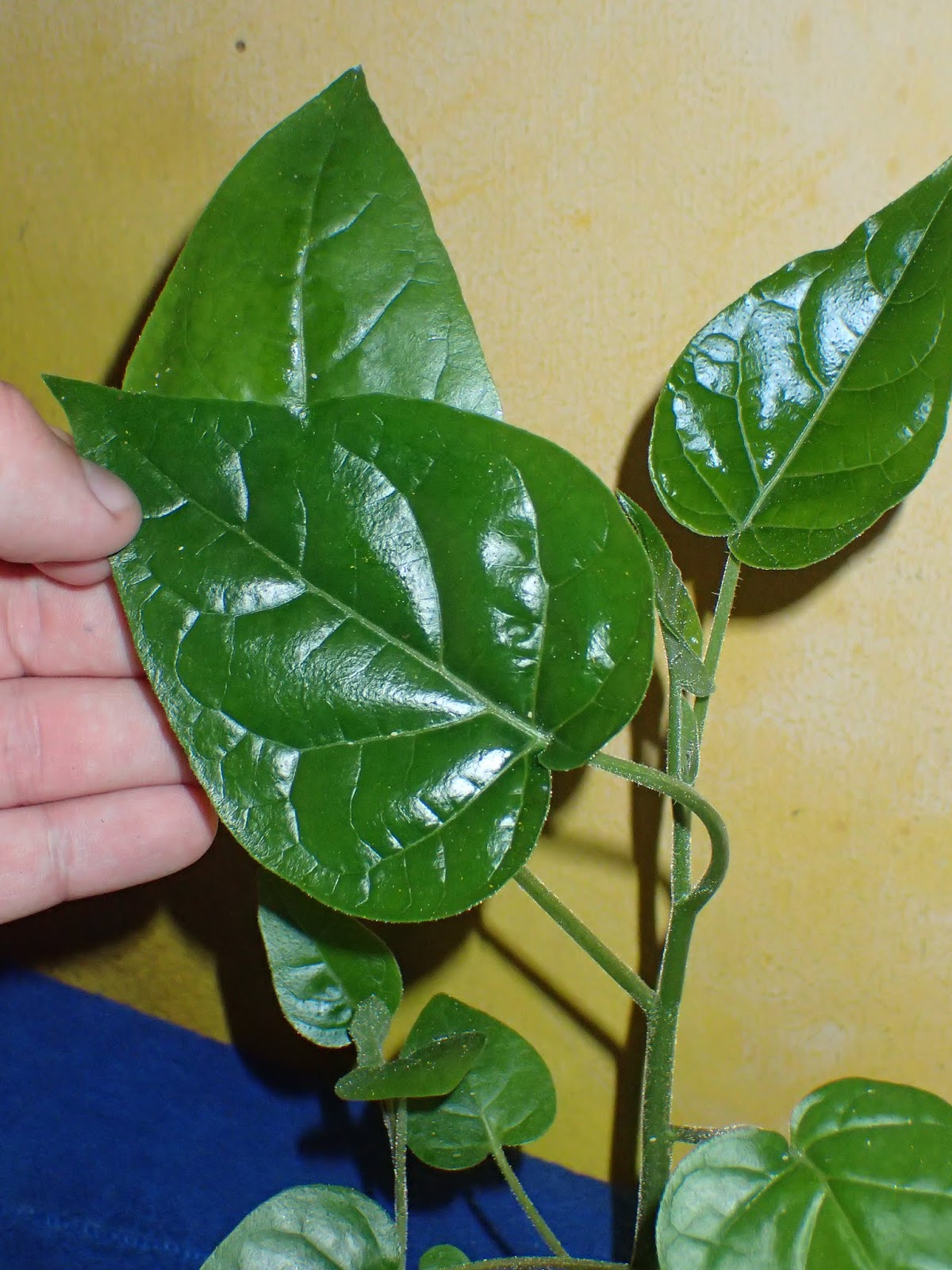
shiny
very shiny
Juvenile leaves lobation, size and color
entire, large, dark green
3(5) lobed (shallowly), very huge, dark green
5 lobed (deeply), medium-large, bright green
Mature leaf size and colour
large, dark green
medium-large, light-bright green
medium, light- bright green
Leaves thicknes
leathery, thin
leathery, rather thin
thick, waxy, rigid
Leaves hairless
glabrescent
almost glabrous
glabrous
Leaves longevity
deciduous
?
half-evergreen
Trunk base thickness
not thick,
slender
not very thick, rather slender
very thick,
conical
Time from sowing of seeds to blooming (in my experience)

about 1 year

about 0,5 year

8 years
Blooming time
(at my northern 50° latitude)

from June

from July

from August
Size of plant when has first flowers
about 0,5-1m
(= 2-3ft)
about 1m (= 3ft)
about 2m (= 7ft)
Type of inflorescence
dichotomous
corymb-like
scorpioid raceme (rarely dichotomous)
scorpioid raceme (often dichotomous)
Young corolla color and shape
purple,stellate
purple, campanulate-stellate, irregulary opened
purple,
funelliform
Older corolla color and shape
lavender-white, stellate
pale lavender, (camanulate-)stellate with a little twisted petals
yellowish,
funelliform
Anthers color
yellow
yellow-purplish
purple
Stigma appearance
small,
inconspicious
wide, capitate, large
wide, capitate, very large
Fruit appearance
pale green, dark green stipped, hairy
?
yellow,
glabrescent

Fruit taste and skin texture

gentle aromatic, mild, tasty raw, skin soft

?
very aromatic, acidous, good for preserves, skin very strong
Frost hardiness
(-8)-(-10) C degree
(= 14-17 F degree)
?
- 3 C degree
(= 26 F degree)
Drought resistance
rather small
small
very resistant
..and the photos:
The most (about 7 for 10 ones in my experience) of seedlings were chlorotic, not deloped well and died fastly
But some seedlings was healthy and green
Young plants
The hybrid had lobed juvenile leaves (as male parent)
Juvenile leaves were usually 3-lobed and huge size
Hybrid plant started to blooming after a few months from seed (about half year old)
It started to blooming in July, so it blooms later than female parent (C. corymbiflora) and faster than male one (C. fragrans)

The stem was interesting maculated

.. and the trunk slender like on female parent, not swolen much
The flower in first day (purple petals)
... and in the second day (pale lavender)
I am trying to make backrosses with C. corymbiflora, because according prof. Lynn Bohs they are viable. In the future I am going to make pollination hybrid flower by pollen of other the hybrid (to obtain F2 hybrids) but now it is impossible because I have only on flowering hybrid plant (it is said to be self-incompatible as parents)


June 13, 2019

Wild Tomato species (Lycopersicon spp.) - part 2

I made a post about wild tomato species on November 2017. Now I am describing a few new species (+ some photos of previously described ones). 
The comparison of fruits of 2 native Galapagos Islands Tomato species - Lycopersicon galapagense (on left) and L. cheesmaniae (on right)
 SOLANUM SECT. LYCOPERSICON
NEOLYCOPERSICON group”
Wild Tomato (Lycopersicon pennellii = Solanum pennellii) this is wild species native to Northern Peru (Piura) to northern Chile (Tarapacá) (dry rocky places and sandy areas at sea level to 3000 m = 10 000ft). It is very different species than others (with specific appearance) and it belongs to monotypic “Neolycopersicon group” – intermediate between tomatoes and potatoes. It is unknown in its fruits are edible or not, but they have rather not bad taste. This species is sometimes used to grafting giant (about 8m = 27ft tall) vine – Solanum ochranthum = Lycopersicon ochranthum (Solanum section Juglandifolia), to obtain small (2m = 7ft tall) plants with fruits in a second year of growing. 
The flowers of Lycopersicon pennellii are very characteristic...
...the same as leaves
The ripe fruits fall down and they break when they are overripe
This is very unusuall tomato species
ERIOPERSICON” group”
Chilean Wild Tomato (Lycopersicon chilense = Solanum chilense) - (sub-)tropical perennial about 1m (=3ft) tall or even more, with silver-gray leaves and stems (often very fragile). Fruits are 1-1,5cm (= 0,4-0,6 inch) diameter, pale green, densely soft pubescent, tasty. I grew 2 accessions (one smaller and one robust – about 2m = 6ft tall). As the most wild tomato species it matures rather lately. Should be sown early.
Smaller form:
This species has characteristic long penducle
Whole plant is very very fragile
Immature fruits
Ripe fruits
Larger form of Lycopersicon chilense:
The characteristic very long penducle
The leaf
The fruits of this form were bicolored

Hairy Wild Tomato (Lycopersicon hirsutum var. typicum = L. agrimoniifolium, L. hirsutum var. agrimoniifolium, Solanum habrochaites) – I described this species before. I tried growing it again in last year but with almost no success. Only a few fruits have ripened. This is the latest wild tomato species. But it grows very large and creates huge, beauty, golden flowers, so it is worth of growing as late summer and fall ornamental in northern temperate areas.
This is very ornamental tomato
It starts to blooming in end of summer and flower to mid/late autumn
It is very very cold tolerant, but not frost resistant
Young fruits
The fruits of this botanical variety has flexible permament hairs
The fruits ripes very late (very poorly in my norther temperate area)

Hairy Wild Tomato (Lycopersicon hirsutum var. glabratum) is very different botanical variety.
This variety has fruits with fragile hairs, which can be easily removed
It flowers earlier and has something smaller flowers and glabrescent leaves
Peruvian Wild Tomato (Lycopersicon peruvianum = Solanum peruvianum) – in last season I grew other (the third) accession. The photos are bellow.
This species blooms very abundantly
The ripe fruits are very tasty (with different aroma than common tomato)
ARCANUM group”
Wild Tomato (Lycopersicon arcanum = Solanum arcanum) – last season I harvested more fruits than in pervious. When it grows in smaller pot it is much earlier.

This species creates long, not dense shoots
... and small firm fruits
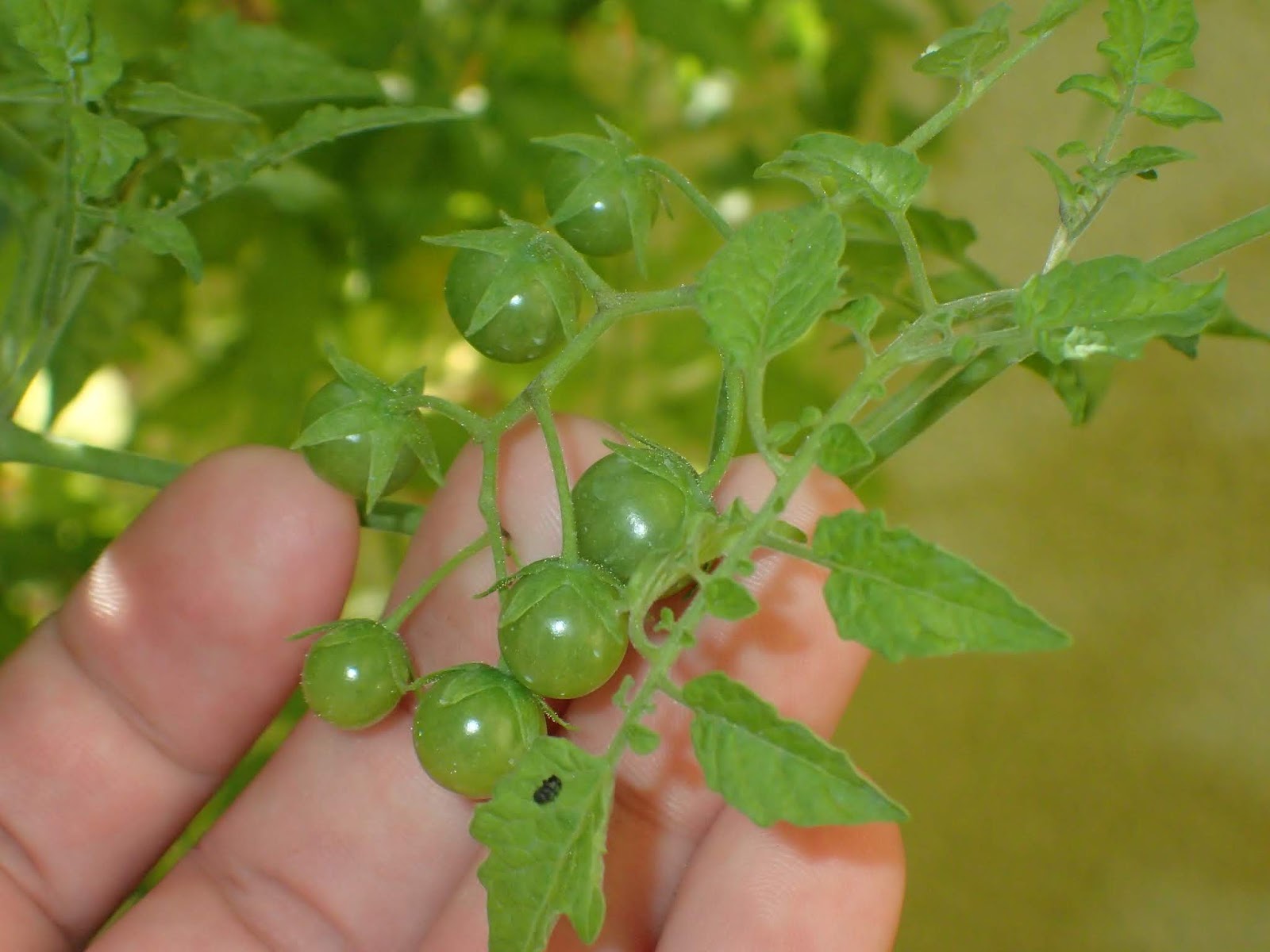
Ripe fruits (about 1cm = 0,4inch diameter)
Chmielewsky’s Wild Toamato (Lycopersicon chmielewskii = Solanum chmielewskii) – I am posting only new fruits photos. Easy, but needs to be sown early. Fruits have specific taste (“lemony”).
The species similar to previous one...
But with something larger fruits ..
... and leaves lemon-like fragrant
 Small-flower Wild Tomato (Lycopersicon parviflorum = Solanum neorickii) – I had no success with this plant, due to dangerous disease (probably bacterial canker) present on the seeds (so I needed to kill young plants and destroy them to not spread the disease to other plants). I will try again, but will soak the seeds in antibacterial Kocide before sowing.
The seeds are very small (the coin on the photo is size about 1 inch = 2,5cm)
LYCOPERSICON” group
Galapagos Wild Tomato (Lycopersicon cheesmaniae = Solanum cheesmaniae) - this is tropical perennial - slender to robust and viny, to 4m (=13ft) in long. Fruits are 0,6-1,4cm (= 0,2-0,6 inch) diameter, yellow, quite sweet and without acidity, very delicious. Seeds small. It grows in nature on Galapagos Islands, on much higher altitudes than L. galapagense. I grew true species, not hybrid.
This species is very different than its cousin - L. galapagense


Ripe fruits are pale yellow
... and mature late

They are very delicious, sweetish
Galapagos Wild Tomato (Lycopersicon galapagense = Solanum cheesmaniae var. minor) – I grew “dense leaf” form last year. I was informed that the fruits of this species are inedible (and ever mildly poisonous! - some sources such said), but it can be not truth.
It have much divided leaves - "fern-like"
... very small flowers
Overripe fruits
Currant Wild Tomato (Lycopersicon pimpinellifolium var. pimpinellifolium = Solanum pimpinellifolium) – I grew true species. It was small plant with long racemes of small (1cm = 0,4inch) diameter, red fruits. Hard skin. Very easy and early.
This species has long, narrow petals
Small red fruits have quite strong skin
The coin is size about 1 inch = 2,5cm
Usual Wild Tomato (Lycopersicon esculentum = Solanum lycopersicon) (a wild form from Florida) – it is very easy and early, very prolific. The vines grows into giant, dense bushes over 2m (7ft) tall. Fruits are about 2-2,5cm diameter (0,8-1 inch), tender skinned and very delicious. 
It has wider petals...
... and larger fruits with soft skin (very delicious)
  SOLANUM SECT.  JUGLANDIFOLIA:

Lycopersicon ochranthum (syn. Solanum ochranthum) - mentioned already above species (tall wood vine, sometimes garfted on L. penellii). I have not sown it in previous season, but I am showing a photo of seeds which are quite large (probably the largest in genus Lycopersicon):
The coin on the photo is size about 1 inch = 2,5cm


Hybrid of Hardy Tamarillo’s (Cyphomandra corymbiflora x fragrans) - current update

 We are pleased to have good news. Just yesterday an article was published about the new varieties of Tamarillo that we later breded. The en...